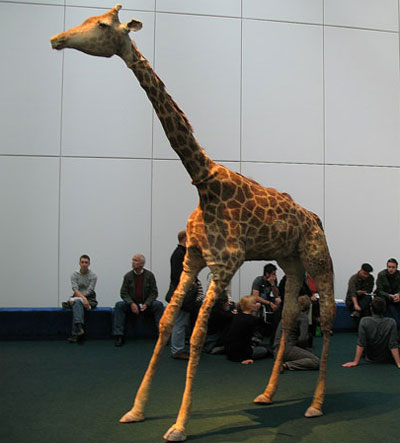
Peter Friedl, "Zoo Story"

Peter Friedl's work "Zoo Story" that was exhibited at the Documenta 12 was a great attention grabber, but is it also a remarkable work of art?
Peter Friedl, exhibited three art works at Documenta 12: "Ohne Titel", drawings from 1968 that the artist drew when he was eight years old, "Tiger or Lion" from 2000, and "Zoo Story" from 2007. Zoo Story was one of the most popular art works and was a central photograph in many of the articles reviewing the Documenta. It's clear that the sad looking nine-year-old giraffe, which died under tragic circumstances in Palestine in 2003, was a great attention drawer.
This giraffe, named Brownie really confused me, I could not make up my mind about how I felt about this giraffe as a work of art. There is clearly a gimmick: a badly stuffed childish animal with a heroic life story is of course an attention-grabber. But there is nothing wrong with a gimmick, if behind the gimmick lays a deeper meaning. And this is where my uncertainty comes. According to the catalog, the artist wanted to "trigger a narrative distinct from the stereotypical impotent media images"; on the surface he managed to do this – we don't really see many giraffes, talk about zoos, or even think about children's leisure time, when the media deals with Palestine. But many visitors to the Documenta did not even know the giraffe's tragic history, or had any idea about Qalqiliya being a town in Palestine. Friedl said that he views the giraffe as a sculpture that can and should help visitors invent stories to go along with it. I feel, that that might be asking too much from the visitors. Brownie fits in very well with Cosima Von Bonin’s stuffed donkey with hat, purple Saint Bernard, and purple bulldog, so that if visitors did not read the catalog or take a guided tour, it’s doubtful how far they could come up with a distinct narrative. For example: one visitor explained the work as "just fun, art for fun’s sake."
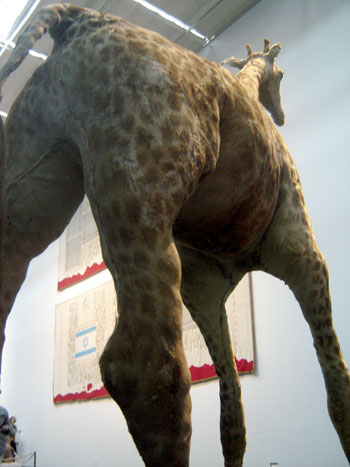
The more the knowledgeable visitor is familiar with the story the giraffe, the more it becomes powerful and touching. The story is great and the act of bringing the giraffe to the show is brilliant. If the story of the journey, the documents of request, the permits, the descriptions of the giraffe going through the check points were also presented, it would have given the work a whole new layer of meaning. But Friedl was not interested in showing us the whole amazing story of how the giraffe came to Kassel. He is interested in the "miraculous metamorphosis of (turning) the dead giraffe into an idea".
This he has done very successfully, but now that it is no more a giraffe, we must deal with the Idea, and as an idea, what is it saying? Is this giraffe-idea dealing only with narrative, and/or perception? Is it touching the Palestinian story in a fresh non-impotent medial way?
Brownie is a great original way of bringing a new angle to the story. But it’s still the same very familiar story, an innocent nine-year-old, dreadfully loosing his life during a military raid in a West Bank town, only to be turned into a "shaheed" (martyr), displayed for glory to the civilized world. Like so many innocent young people in Israel and Palestine, who died in this never ending conflict, having thier small bodies, short life and own self get turned into an idea. Sorry, this is quit a disturbing thought; I think I got carried away.
So maybe the idea has nothing to do with Palestine, or conflicts, or even innocent animals. Could it be that Brownie was brought to the Documenta to ask questions about art and its place in dealing with conflicts and the political ? Moreover, is Brownie just one of the experimental ways of speaking about art and challenging the limitations of our western ways of thought?