/ magazine
| Charlotte Misselwitz | 2007-10-26 21:39:03 |
The Liminal Spaces Artists exhibited at Documenta 12 expose deeper layers of art dealing with Middle East politics
In the final session of the launching conference of the Internationl art project “Liminal Spaces” everything - its political and artistic aspects - got turned upside down. When the theorist Charles Esche talked about “engaged autonomy”, in which one should “retain a critical position while we live affirmation in every-day-life” things were still smooth. The director of the van Abbemuseum in Eindhoven talked about modesty: how “speculations” rather than “ideologies” would be the advantage of art compared to politics, how “ambiguity” is its potential… and then things weren’t smooth any more. The word ‘ambiguity’ changed everything, at least for Ayreen Anastas, a Palestinian artist living in New York. What can be considered the newest stand in Western philosophy got attacked: “I don’t agree! In a project like this you have to be as clear as possible. The occupation of the Palestinian people is nothing ambiguous.” Obviously, ambiguity as potential for the project was considered ambiguous.
Lunch got cold, as the debate got hot for the approximately 30 artists and curators from Israel, Europe, the U.S. and the Palestinian territories, Stuffed in a rented furniture shop, just off the main road to Ramallah, one and a half years ago. Situated along the frontiers of Israeli and Palestinian territory the project tried to “refute possibilities of art within political frameworks”. With the money from Israeli and German foundations like Heinrich Böll or Goethe and support from the EU, exhibitions and further meetings in Israel and Germany followed. On October 25th to 27th the third meeting of the group will take place in various locations such as Bil’in, Lydd/ Lod, Ramle, Jaffa and Tel Aviv.
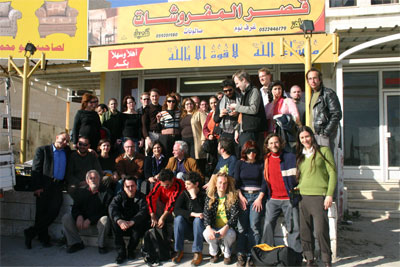
Liminal Spaces participants in front the rented furniture store in Qalandiya, march 2006
The ambiguity once encountered, became the thread running through the project’s story. Even though the stance of Liminal was very clear, all participants opposed openly to Israeli occupation. The recent example of the “Documenta 12” exhibition this summer in Kassel however exposed the deeper layers of art dealing with Middle East politics. Three artists from “Liminal Spaces” got invited to the show. One Israeli, Yael Bartana, and two Austrians, Peter Friedl and Simon Wachsmuth. Yet, from Liminal Spaces, no Palestinian artists took part. In Documenta 12 in general, among the eight International artists dealing with the Middle East conflict and the "Muslim Other", there was only one who spoke from the position of the other, herself., Ahlam Shibli (who is a Palestinian Israeli citizen). Maybe ambiguity found its expression in imbalance. Certainly, judging from Documenta or “Liminal Spaces”, there is a Western preoccupation with the former or present “Orient”, Roger Buergel, the curator of one of the art world's biggest show, calls a “key issue”: “Validity claims between Christianity and Islam always existed.” Today the only difference is that the conflict “is a globalized one.” Now the question is, does the preoccupation itself embody ambiguity?’ Looking at the three Liminal as well as Documenta artists and their projects the layers get more obvious.
Indulging in “liminal spaces” means loitering in no-man’s land. Confronting a video about present day practices of a Persian dance with a centuries old mosaic about Alexander the Great during the Persian wars, says something about limits. It looks like a search for the “Muslim other.” The installation by Simon Wachsmuth played with ancient and present projections. Black and white sticks randomly placed, hint military tensions as well as the one-sidedness it requires for each world. If occupying a position on both sides of a threshold means crossing boundaries, then Iran might be the ultimate boundary.
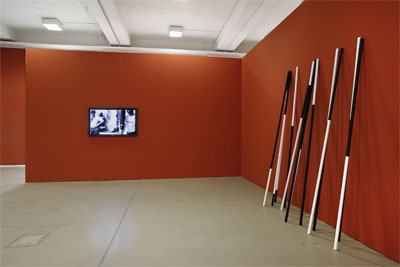
Where We Where Then, WhereWe are Now, 2007.
Simon Wachsmuth at Documenta 12. photo: Roman März
Wachsmuth himself is surprised about this fascination. The Vienna and Berlin based 42 year old , should share the emotional distance of Europeans to the Middle East. However, he decided to break nothing less than the “binaries”, the black and white perceptions between the West and the Arabic world. The moderate smile of the dark-haired man dressed in slightly lighter dark looks genuine. He also thinks he has the necessary distance to deal with the topic. The two thick book covers that he drops on the table look old and used. “What is this? My school atlases! Only now I understand what this means, in the shadows of the Persian realm”. Border lines, explanatory texts, all in Hebrew letters. When his father was a correspondent in Israel, the little Wachsmuth went to an Israeli school. So much for distance. “I’ve been once completely influenced by Zionist doctrines!” he exclaims.
Zionism or Western readings about its presence in the Middle East are Yael Bartana’s, the Israeli artist’s, main target. In her video she colours – so to say - contexts which used to be in blue and white into green, white and red. Employing the style of Israeli nation building narration she films the reconstruction of a Palestinian house. What was destroyed by the Israeli Army gets repaired by the new pioneers: Jewish Leftists and Palestinians. Bartana knows the Zionist reading not only from school. The personal connection reaches right into her closest family. “My dad was a terrorist”, says the 36 year old. The smile of the short haired woman almost hides the seriousness in her eyes. Her father was a member of the Hagana. The Jewish organisation fought as early as the thirties for independence against the British occupation, using explosives. But her family no longer talks about politics, ”because, as soon as someone starts with it“ – she snaps her fingers – “there is a big fight within seconds”.
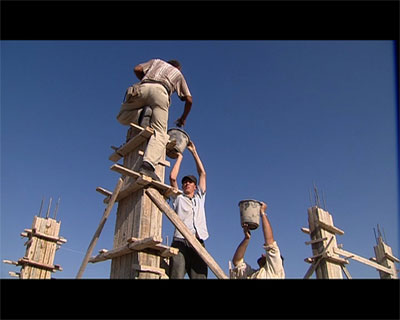
Summer Camp, 2007. Yael Bartana. Video Still
The preoccupation with the “Muslim other” in the case of Bartana or Wachsmuth turns out to be a coming-to-terms with their own identity. It seems to provide the missing half in the artist’s political, cultural or historical understanding of the world. Their preoccupation with the “Muslim other” is paralleled by the preoccupation of Arab artists’ from Liminal with themselves, however from the position of the ‘other’. In the case of Documenta, this trend of speaking about the “Muslim other” collapses when the agency is in the ‘other’s’ hands. The trend can only be performed from one side.
Ahlam Shibli’s photo series in Documenta might be an offensive attack on this ambiguity, the imbalance in the trend. Black and white pictures of families from her place of birth, a village in the Galilee, show life before Israel took over the territory in 1948. Present day photographs of mountain shaped lonely landscapes hang next to crowded images of the village population in a Jordanian refugee camp. Shibli chooses to tell her own story. There is a level of certainty and clarity in the thesis of her work, which makes no room for Esche’s ambiguity, the very dynamics which Wachsmuth assigns to the “Western terms of art” which dominate the discourses; the terms are predetermined through a Western aesthetical and political understanding. Sitting in his Berlin studio and playing the video about the Persian dance, he acts within all these ambiguous preconditions. The spacious working place in the bourgeois but cheap old Berlin apartment is located in the heart of Western discourse. Yet he is the one to point out: where the terms get created the power of interpretation is located.
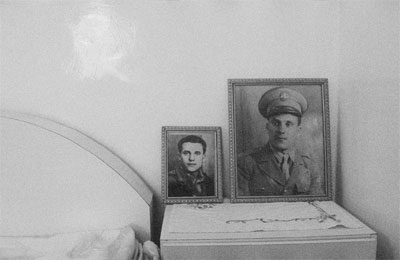
Arab-al-sbaih, 2007. Ahlam Shibli
Likewise, in a café in Ramallah the world looks differently. With Israeli army vehicles driving by outside, the conflict can no longer be looked at with emotional distance. From an every day life perspective it is banal and bitter reality. Ahlam Shibli, Ayreen Anastas (who spoke up against ambiguity in the beginning discussion) and Reem Fadda (co-curator of the project from the Palestinian side) are all from the same generation. With her 27 years, Fadda might be the youngest, but not in intellect or experience. Having studied history of art in London, the Palestinian still speaks in the clean American accent gained from her special education in Jordan. She chose a Western style café that serves Hamburgers to meet. Readjusting her glasses, Fadda explains how ambiguities to her generation are more alien than for elder generations who had seen different times. Up until the first Intifada 20 years ago, Israelis and Palestinians used to interact in their everyday lives much more frequently. “For me it was always strange hearing my grandfather talk about this beautiful Jewish woman in his neighbourhood. Jews here in Ramallah!?” Striking back her long curly hair, she smiles. Today, reality looks simply much more black and white.
If not emotional, the West has geographical distance. Back in Berlin the third one of the artists invited to Documenta, Peter Friedl, says: ”Art doesn’t end in its representation. Context is just as important”. From his roof top apartment - which he only rents “temporarily” even though he lives there for ten years already - such oversights come naturally. The vertical distance to the ground seems to reinforce the geographical one. With a present exhibition in Madrid the globalized artist has recently been in Ramallah again. Like many from the project he stayed with Reem Fadda or other participants who became his friends. “Their biographies might be realities which cannot be redeemed by the longing for representation. This is a contradiction one has to endure.” His conclusion: to reconnect art with story telling. In his Austrian accent Friedl talks about the “medial overkill” of the Israeli-Palestinian conflict and how artistic formats of the image have already been exhausted.
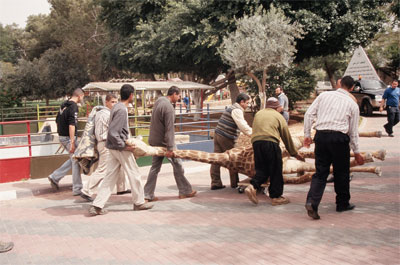
Zoo Story, 2007. Peter Friedl. Transport of giraffe in Qalqiliya, Palestine
The wiry middle aged man with small blue eyes is the artistic father of Brownie, the piece of art which caused the biggest furore in Documenta. Without any explanation, the Giraffe stood in the central hall and the audience had to find out about the stuffed animal themselves. Having died in 2002 during an attack by the Israeli army, it belongs to the Palestinian Zoo in Qalqilla. This image’s interdiction Friedl imposes upon himself with hopes to undermine Western terms of art. Seemingly, Esches understanding of ambiguity plays with art as space that doesn’t narrate. Friedls refusal to use formats might play right into that. But simultaneously the artist points towards narratives even within the neutral realm of this ambiguity.- definitely a process after the beginning discussion and Anastas’ objection.
Yet any preoccupation with the Muslim world is ambiguous in the sense of imbalance. No matter how globalized Friedl may be, or how involved in the investigation of ‘the other’ and thus their own identities Wachsmuth and Bartana can be, there is an imbalance in the Western art world’s representation of the Middle East. The structure of the trend, it’s deficits, is what “Liminal Spaces” brought to the surface. At the same time this embodies the projects potential. Ambiguity in the arts cannot be more ambiguous. The emotional proximity in Shibli’s, Anastas’s or Fadda’s reality still challenges forms of representation. In “Liminal Spaces” there was little ambiguity in its thesis about Israeli occupation, which has brought the project further than any other peace work or the Documenta. Its creative potential is in the International participants’ joint journey into all of these grey zones, be they good or bad, but most importantly – in the face of ambiguity.
Much like Friedl’s Brownie, there is a new dimension as it is dealing with ambiguity and its imbalance openly. While Brownie is on his way home now, we can first consider him a Giraffe. Then, according to certain characteristics, he is Palestinian – an inhabitant of Qalqilla. He is the protagonist of a story which is sad, formless and continuing. But the animal is dead. Exhibited in Kassel, inserted into the Western world of art, he stayed absent. Back in the Zoo he will continue to stand with his body slightly bent, pointing towards the ‘other’. Dead Brownie is the absent Arab – whose unfulfilled longing for representation we all have to endure.