
/ reviews
| Galia Bar Or | 2005-11-13 18:02:36 |
On Larry Abramson’s Pile
For Larry Abramson, the Felix Nussbaum exhibition at The Israel Museum, Jerusalem (1996), was his first meaningful encounter with the power of Nussbaum’s oeuvre, with his character as an artist and with the steps forced upon him by history. A few years after this Abramson experienced a period of crisis – personal, professional and political – following which he began, in 2002, to draw the “Pile” series, which centers on images of accumulations of building waste that have piled up in the landscape as a result of the collapse of buildings. This turn to drawing from “nature” entailed something of an attempt to take hold of seemingly negligible and trivial everyday matter, by means of a recurring manual action intended to “motivate” a dynamic, to kindle a connection between the eye and the hand, and to bring about a renewed movement between “world”, psyche and consciousness. The “Pile” series linked two genres Abramson had engaged with previously – landscape and still life painting – and became a focus of a fascinating dialogue that he initiated with Felix Nussbaum: “To me, Nussbaum was a chilling example of a person who had history invade his studio and force a fate upon him; even had he wanted to, he could no longer make art that was not in history. I remembered this when I thought: Here I am alone in the studio, things that were dear to me have collapsed and vanished. He became a model for me, an interlocutor”.i
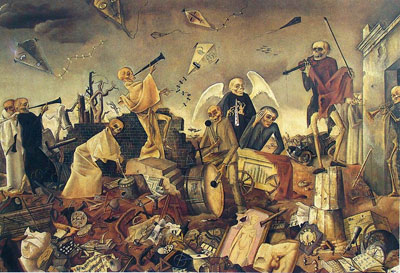
Felix Nussbaum, Triumph of Death
“We Are All Felix Nussbaum” was the title Abramson gave to an essay he published in that period (June 2002), which dealt with the relations between art and history and related to Felix Nussbaum and to his last work, Death Triumphant, a painting he managed to complete in his hiding place in Brussels, before he was caught and later murdered in Auschwitz in 1944. Abramson related to the pile of broken vessels depicted in Nussbaum’s work, and added:
“If a History of Art exists it is lying right there, in Nussbaum’s painting – in that stinking and non-hierarchical pile of Classical, Neo-Classical and Modernist debris…under the dancing feet of the angels of death in their chilling celebration. We are all Felix Nussbaum, painters without an audience, giving silent testimony in our underground studios”.ii
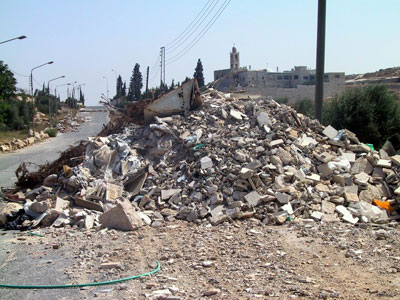
Mar Elias 1
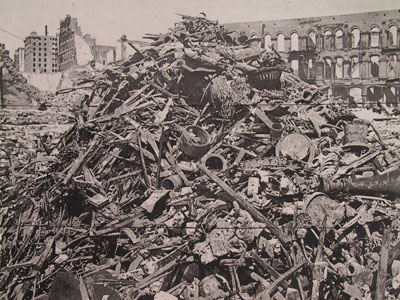
San Francisco debris, 1906
In his essay, Abramson referred to an image taken from the writings of Walter Benjamin – that heap of ruins that piles up before the gaping eyes of the Angel of History as he is pushed backwards in the gust that sweeps the spirit of progress along. Benjamin described history as waves of ruins collapsing upon one another – a baroque image in 17th-century allegories – and saw history as a crumbling that cannot be halted. In his conception, history does not bear witness to an irreversible movement of progress, catastrophe does not occur as an event but goes on continuously all the time, and the state of emergency is the norm. In the conception of redemption that he developed, Benjamin was influenced by a secular form of Jewish apocalyptics: rehabilitation of the history that had been corrupted with the “breaking of the vessels”, and redemption of the historical past. “Remembering”, in Judaism, signifies the re-materialization of events of the past in the experience of the present, with a constant intention to restore to life that which has been forgotten and has not been acknowledged.
Benjamin warned against the apologetic temptation of the “victims of history heritage” that was not meant to be re-activated in the struggles of the present but rather to serve as a simple nexus of commemoration. He believed in “repair”, although not by means of painting an “eternal” picture, but by means of a leap to beyond and outside the succession of conventional time, to “the time of the present”, which is linked to the notion of the revolutionary element or the notion of the Messiah.
Abramson concluded his essay in a Benjaminian spirit: “And who today shall stop, raise the dead and mend the pieces? For this mission we need more than New Historians. For this mission we need, as always, artists”.iii That same year Abramson traveled to Osnabrück, the city where Nussbaum was born, to visit the museum dedicated to the oeuvre of Felix Nussbaum. There he met Inge Jaehner, the Museum Director, and with her began to crystallize the idea of the “Pile” exhibition at the Felix Nussbaum Museum.
Abramson’s use of the term “artists” in his ethical-historical discussion, “We Are All Felix Nussbaum”, is not a casual one. His appeal to the artists is charged with a sense of emergency that is conscious of the significance of the task he has set – for them as for himself – “to mend the pieces”. Abramson knew that the answer would not be found in the reflexive and hermetic art language. Since the beginnings of his work in the ’70s he has grappled with questions touching upon the art language, has critically examined the convention of the artistic genre, has turned to the alternative of concrete historical experience, and has striven to create a connection between art and the “world”. From his own experiments he has experienced the obstacles of theory and convention and found that the closed pattern of rules contains the trap of reification of consciousness. The artist’s task, which is always individual, entails a critical approach to the images that are identified with civilization, or, in Benjamin’s words: “There is no document of civilization which is not at the same time a document of barbarism. And just as such a document is not free of barbarism, barbarism taints also the manner in which it was transmitted from one owner to another”.iv
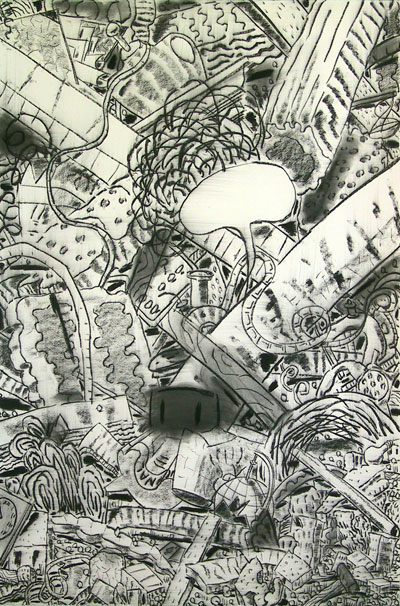
Felix's Pile, detial (press for full artwork)
“We learn to see a thing by learning to describe it”, Raymond Williams wrote in 1961.v Description of reality is an acquired social skill that structures the character of seeing. It also seems that John Berger’s discussion of “Ways of Seeing” (the child learns to see before acquiring language)vi necessarily brings in actions such as identifying, sorting and interpreting – a visual perception that of itself assimilates a system of social, cultural and political conventions.
Already structured into any seemingly innocent landscape scene there is a complex cultural context, oriented to values such as the “exotic”, the “sublime” or the “pastoral”. The landscape painting that echoes these assimilated values signifies (also unknowingly) power relations, and it itself serves as an instrument for the structuring of cultural power. If early landscape painting declaredly signified proprietorship of lands, then the movement of landscape painting towards modern and abstract painting connotes a “liberation” the political contexts of which are more concealed from the eye. Landscape painting has become an artistic practice that embodies the definitive “individual experience”, with all the Western, national, and class values that are associated with it. The painting of a landscape scene accords the artist the status of an observer who is, on the face of it, not conditioned by social systems – the point of view of an “innocent eye” that transmits a “presence” and passes like a torch from one great artist to the next, constituting the story of art as a whole.
The task of “mending the broken pieces” takes on a troubling meaning when the “past”, of history and of art, is perceived as shaped by a hermeneutic tradition that selects events and uses them to sketch an image of the past as a “history of victors”, which is passed on as a natural datum from generation to generation.
In 1984 Larry Abramson began working on the “Nevo” series of paintings, in which he grappled with the genre of landscape painting in the typological context of the “sublime”. With a sharp intuition, in this series Abramson touched upon an expanse of cultural, social and political contexts that intersect in this genre, even before these were defined explicitly in the art discourse. In “Nevo” Abramson engaged with the observation position that blends a sense of power and liberty (creation from the height of God’s gaze) with an element of longing, eternally unfulfilled, for expanses of the horizon beyond the scope of human attainment. The local, emotional, and political context of his work is embodied in the title “Nevo”, and in the figure of Moses who ascends to the height of the mountain’s summit where, spread out beneath him, from horizon to horizon, lies Eretz-Israel, as the topos of desire. “And Moses ascended from the plains of Moab to Mount Nebo to the top of the summit that was above Jericho, and JHWH showed him the entire land” (Deuteronomy 34.1). Moses, the consummate leader, attains to the gaze that constitutes Eretz-Israel as a desired landscape scene, “and to there you shall not pass”.
From the angle of the present discussion a question arises – how will Moses (or the artist) mend the broken pieces while he is still standing opposite, in the position of the observer from afar: on the face of it he creates a world, but his location, even on top of the summit, is not an Archimedean point from which he will be able to move the world.
“The question that I always ask is: Where am I standing? At one time I stood opposite, in the “Nevo” paintings, but I understood that I couldn’t lament the unattainable for ever. I said: I’ll reach out a hand and take something from the ground beneath my feet. I’ll be like the biblical spies who, to represent the land they saw, bring back a concrete object and, there on the desert’s edge, make a still life of a bunch of grapes. Not in order to speak about grapes but in order to speak about an idea, a space, a whole that cannot be perceived except through its parts. And what did I pick up from the ground? A plank, a branch, anything I can hold on to. The square itself” (Abramson).vii
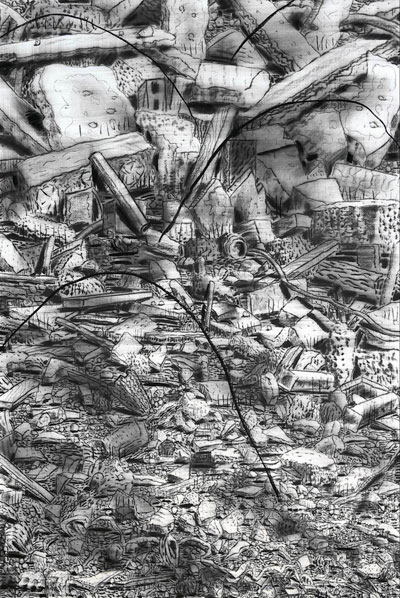
Larry Abramson, Rechavia XI (from the Pile series), 2002, charcoal on paper, 174x115cm (coll. Israel Museum)
Abramson reaches out a hand, takes an object from the ground, and focuses on it. It might be possible to replace the position of the observer with an everyday involvement in time, in “duration” (Bergson’s “durée”). But if duration has no beginning or end and no history in the sense of determining a meaning in time, it entails a kind of experiencing that lacks consciousness. “A plank, a branch, anything I can hold onto” – the banal everyday object may awaken an involuntary memory and bring to life at one stroke a hidden world of the past, like Proust’s madeleines. Involuntary memory is not conditioned by the authority of the reason and is therefore liberated from norms, but in a period that has absorbed Freud’s doctrine it is difficult to still rely on an associative remembering over which there is no control. Involuntary memory and remembering are composed of forgetting no less than they are an act of recollection. Awareness of the mechanisms of repression makes for a more pointed alertness to the fact that the really important thing, like a trauma, cannot be remembered, and that the prevalent trap is the trap of empathy: identification with personages, with heroes, with victors. The question is how, in aware remembering, can one blend two materials of memory – the individual and the collective – while preserving a skepticism about any method that abandons man to mechanisms he has no control over. The posing of this question inevitable entails the striving to arrive at remembering as an authentic involvement in time, an involvement in which contents of the individual past and contents from the collective past appear simultaneously.
Abramson grappled with the question of memory in the “tsooba” series, which was painted during 1993-1994 and discussed the “legacy” of abstraction of the Israeli landscape. He was aware that the way the past is respected as “legacy” is more harmful than its simple disappearance could ever be, and he investigated what had been ignored by the gaze of the modernist Israeli landscape painters: the ruins of the Arab village Tsuba, which had been emptied of its inhabitants in 1948. The series, which contained landscape paintings of the ruins of the village after a photograph through a telescopic lens, imprintings of the landscape paintings on newspaper pages, and still life paintings of branches that had been gathered at the site, focused critical interest on the tradition of the landscape painting genre, and principally on precedents that the genre supplies for that which has been deprived of the possibility of being seen and represented.
In the second half of the ’90s, Abramson added another series to the discussion he was conducting with the history of art – the “Giornata” series, containing paintings resembling fragments of Roman frescoes, which set up an additional tier in the structure of Abramson’s engagement with the question of the status of the art work, the status of the concrete object as a metonymic memory of a lost whole, and the status of “leisure” and its destruction.
The “Pile” series (charcoal on paper, 2002-2004) groups together aspects and conclusions from Abramson’s previous works, and continues the discussion with a stratified system of contexts of the concepts “landscape” and “still life”. Abramson does not leave be the troubling question of how one may enter the world of real materials as a participant rather than as a voyeur, and how one may represent the everyday without losing the qualities of the unexpected in the mundane.
Although Abramson’s dialogue with Nussbaum has been a continuous one, most of the sub-groups of the “Pile” series contain no direct references to Nussbaum’s works, nor any elements from the earlier works of Abramson himself. At the later, mature stage of the series, objects that Abramson engaged with extensively in the past, such as the skull, seep into the works, and in the last work of the entire series, Felix’s Pile, there are also objects from the “pile” in Nussbaum’s last painting: the artist’s palette, a microscope, barbed wire, a clock, an easel, a book with alchemical symbols, musical instruments, etc.
The early works in the “Pile” series include material elements such as concrete beams, pipes and bent rods of iron – the hard belly of the building that has collapsed inwards – as though Abramson wanted to enable the truth content of the period to appear by means of its material content. The early piles have a white expanse of sky, and a horizon that cuts the paper breadthwise in a perspective that strives for depth. This is a spatial perception familiar from landscape painting, but the course of his work on the series dictated to Abramson a movement of descent to the mundane and a lowering to the trivial basis of life. In the genre of still life the painting is not a window to the world, it contains no vanishing point, and the openness to the horizon of the distant landscape is replaced by a penetrating and close-up gaze that focuses on a body. What opens up here is the disparity between “landscape” and “still life”, and in Abramson’s piles all the contrary categories are heaped up together: the sublime, the anonymous, and the worthless.
The relative proportions of the components of the “Piles” to one another are ambivalent, and the details of the paintings at times recall concrete objects and at times can be seen as body parts. In the course of the work Abramson conducted an inner dialogue with art history, as, for example, in the recurring movement between abstract, object and body, which brings to mind to the significant work of Philip Guston.
Later in the series the pile began to fill the boundaries of the frame from edge to edge. The painting space became inverted, and the upper part of the pile pushes forward until it seems that the body of the painting rises up over the imaginary space of the viewer. The format of the drawing gradually grew, and received a vertical structure, more bodily than landscape-like. From now on the “still life” of the pile is a tactile space that is in motion: it rises upward, collapses to the sides, its components join together and break apart, it winds and turns but is not tempted into caprices. Abramson builds a space that is sober, uniform, and without any hierarchy, in which every point and every line, every broken stone and pipe end, are important.
“I know what my art aspires to be. It aspires to be the pile itself. How to achieve this, how to achieve a state in which I too will be in the pile, where I too will be the pile? I’m concerned with the technique of routine, the procedure of the mundane. In the pile there is no conceit, no pretension of Eureka! I’ve discovered!” (Abramson).viii
Abramson’s drawing does not use a technique of deception, and in the “still life” of the pile there is nothing of the self-confirmation characteristic of the classical genre; there are no representations of proprietorship of objects or of excess. The range of sensory possibilities that the pile offers is modest, and it has no desire for painterly stratagems. Abramson refuses to invent for the sake of invention, and does not seek to ascend to lofty heights: the descent to the pile is a move of personal work that aspires to a lowering of the ego, both in intention and in action.
The pile is an abandoned still life in which there occurs no metamorphosis of material, not by means of proprietorship, or management, or placing into a frame. Its origin is building rubble piled up by contractors, rubble usually found in dump sites on the outskirts of towns of the kind that in the Third World you may run into here and there on a limited scale as part of the city scene. The still and abandoned landscape signifies a scene that the landscape painters did not engage with, a space of vagueness (“espace vague”) that responds to a different order in which function is piled upon function in a spatial organization whose logic is different to the one we are familiar with. In the language of Western art and culture no terms have been coined to describe a landscape scene of this kind, but only by means of acknowledgment of it can a struggle with the concrete reality of life become possible.
The Abramson-Nussbaum dialogue, which found expression in late 2004 with components from Death Triumphant entering Abramson’s work, is not solely thematic. It appears that in Death Triumphant the “landscape” genre blends with the “still life” genre in order to create an associative world, dialectical in character, that charges the work with cultural depth and with dismal despair. From among the skeletons and the ruins a landscape of low hills appears in the painting, revealing a low horizon; the sky takes up more than half of the area of the painting, and in its depths a lone horseman rides. On the forward and the central plane, between a classical marble structure and a ruin – as in a theatrical grotesque of “The Adoration of the Magi” or “The Gospel” (in a horrifying inverse of a serene Renaissance picture) – creations of the human spirit are scattered in confusion, like after a pogrom. The orchestra of skeletons, which might have emerged from the drama of a medieval morality play, celebrates with hollow eyes the “Gospel” of death on the ruins of the old world. It makes a laughingstock of the format of the “still life”, which with refinement and skill simultaneously signified both a world order and man’s fragile grasp of it. Here it is in its nakedness, this “still life”, this pearl of the cultured West’s creation, and it is a vanitas that carries signs of violence, an absolute and final vanitas situated in a landscape of desolation. From the sky that once bore a promise of the experience of the sublime now gaze only kites with eyes that are painted and empty.
Larry Abramson’s dialogue with Felix Nussbaum entails a dialectical experience of a unique and unmediated encounter with the past, but no less important than this, it entails an acute and contemporary sense of the present. In a contemporary world that is ruled by huge corporations and that adopts simplistic ideologies, the patron of art is no longer the bourgeoisie, whose values art promoted or challenged from a critical position – and the dialogue was meaningful. The status of the patron is today taken by the global society, which promotes a universal design of life, a society in which the distinction between art and design is becoming more and more blurred and in which the possibility of imagining an alternative is becoming more and more limited. In the world of our times, in which there is a prevalence of artistic practice that adopts values of synthetic production and submerges the sense of reality in a detached dream world, one almost cannot find true work on history, on art, and on the history of art. Larry Abramson’s work proposes a reprocessing of history in terms of content, involvement and thought. “…he grasps the constellation which his own era has formed with a definite earlier one. Thus he establishes a conception of the present as the ‘time of the now’ which is shot through with chips of Messianic time” (Walter Benjamin).ix
1. Larry Abramson in a conversation with the author, February 2005.
2. Larry Abramson, “We are all Felix Nussbaum”, Studio 133 (May-June 2002): 68-69 (Hebrew).
3. Ibid.
4. Walter Benjamin, “Theses on the Philosophy of History”, in Illuminations, ed. Hannah Arendt, Schocken Books, New York, 1969, p. 256.
5. Raymond Williams, The Long Revolution, Penguin Books, Harmondsworth, 1965, p. 39.
6. John Berger, Ways of Seeing, Penguin Books, Harmondsworth, 1972.
7. Larry Abramson in a conversation with the author, February 2005.
8. Larry Abramson in a conversation with the author, February 2005.
9. Walter Benjamin, “Theses on the Philosophy of History”, Appendix A, p. 263.