
/ reviews
| Claudia Liebelt | 2008-01-05 16:40:32 |
Art not too different from the Christian kitsch in the souvenir shops, simplistic political messages and insensitivity to the local population? Banksy and his celebrity street art posse celebrate Christmas in Bethlehem
In mid-December a UK based self-described ‘squat art concept store’ named Santa’s ghetto moved into a former chicken shop on Manger Square in Bethlehem, right across from the Church of Nativity. As the birthplace of Christianity, this place attracts tens of thousands of pilgrims annually during the month of Christmas. While it can be assumed that most of these pilgrims did not take notice of Santa’s ghetto, this December, there were some pilgrims in town, which did not come for the usual Christian sights. The gallery’s main organizer and featuring star is Banksy, pseudonym for a UK graffiti artist, who is generally described as celebrity feted, but – stimulated by his often mused about anonymity and given that his works now sell for hundred of thousand dollars – has become a celebrity himself.
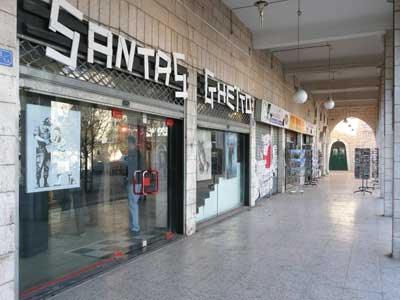
Santa’s Ghetto gallery in a former chicken shop
on Manger Square in Bethlehem
Banksy, Alongside other well-known street artists like Blu, Sam 3, Erica il Cane, Paul Insect and Ron English, has spent days painting walls in and around Bethlehem, including The notorious separation Wall, of course, which runs in ultimate proximity to the city, cuts it off from Jerusalem and at its entrance to the city resembles an international border crossing between enemy states, with its watchtowers, eight meter high concrete wall and sterile corridors of turnstiles and surveillance cameras. The wall is no unfamiliar site for Bansky which bears several of his famous works of art from a previous visit back in 2005.
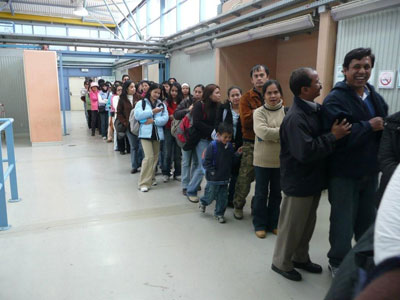
A group of Filipino and Sri Lankan pilgrims
queuing at the Bethlehem crossing
Loving radical street art and being a sympathiser of much of Banksy’s style and humour, and even though the project has produced largely positive reactions in the world of political and art blogs I nevertheless found myself rather disappointed from visiting Santa’s ghetto in Bethlehem. There are several problematic aspects, which in my opinion do need attention and debate.
Solidarity against the Palestinians?
The accusation that Banksy and his colleagues engaged in solidarity that does not understand and respect the local population has been voiced out a lot in the debate on the project, interestingly often within the mainstream media. In one of its weekend editions during December, the Israeli daily Ha’aretz, for example, implied that Banksy’s art was largely unwelcome by the local residents, many of whom feel offended by it. Does the donkey that has its papers checked by a soldier – one of Banksy’s most frequently quoted murals in Bethlehem – represent the Palestinians? Is this offensive and wrong solidarity, then? Indeed, rumour goes that several works have already been removed, mutilated, destroyed. According to CBC News, the above described donkey had been painted over by locals less then two weeks after Banksy created it, on December 21.
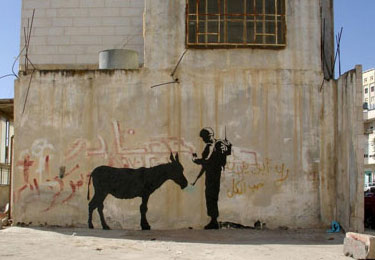
A work of Banksy in Bethlehem before it was painted over by locals
Moreover, Ha’aretz as well as others criticised that the immense prizes of the art works available in the Bethlehem gallery – the gallery’s guide prize list started with five hundred dollars and went up to half a million dollars - were completely out of reach for the local population, who suffers badly from economic depression under the occupation. While such accusations are easily made, it has to be noted that with the gallery’s policy - according to which only those, who actually came to Bethlehem, could participate in the auction - the art world was confronted with a social reality quite different from London, where it usually takes place, this potentially leading towards an increased awareness of, knowledge on and action against the occupation. And while at least some of the group’s murals will certainly stay in Bethlehem and continue to enrage, but also make its residents and visitors reflect and wonder, the auction’s revenues have been promised to non-governmental non-party-affiliated local children’s projects. Talking about solidarity and direct political impact, this certainly large sum of money should not be forgotten within the debate.
Street art and the gallery
It has rightly been stated that street art belongs to the street, not in a gallery. The canvas of a peace dove wearing a bullet proof vest by Banksy, for example, looked like a too realistically painted, rather kitschy peace movement poster in the Santa’s Ghetto gallery. The same motive on a wall right beside the street which up to 20,000 pilgrims passed upon entering Bethlehem for Christmas this December, though, is a different story. As the bullet holes along its top attest to, this is the spot where more than forty people were killed during the first Intifada, so said the blog of Santa’s Ghetto before it was closed down on December 25 (cf. www.santasghetto.com). It went on to tell that ‘[w]hile Banksy was painting it a lot of people came over, some to shake his hand and others telling him to go away. Eventually the local MP was called out to diffuse the eighty-strong crowd that had built up (by which time Banksy had left and the piece was completed by the local kids)’. Great street art is much more than mere witty motives or decoration: it is a political intervention, an assertion to the right of public space, a claim that generally takes place in a politically contested, violent and history-laden space. Even though one can argue about the motive, in this instance, Banksy’s art becomes what street art is all about: a collective happening, a form of subversive commemoration, a political claim.
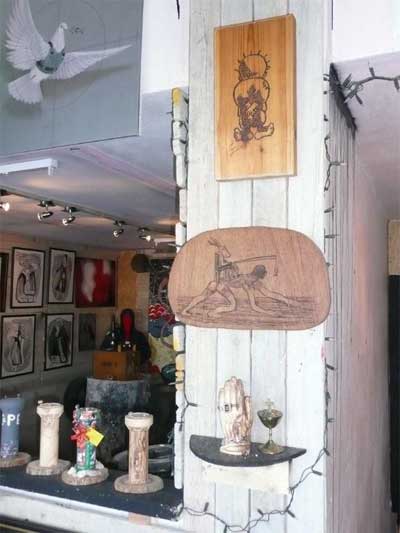
Banksy’s ‘Peace Dove’ in the gallery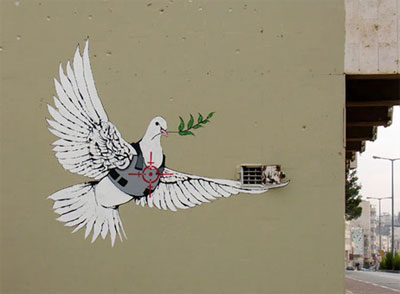
and on a Bethlehem city wall
The Art of Making Political Art
But let’s return to the gallery. While some of the art displayed here looked as if it was actually Christian kitsch from one of the adjacent souvenir shops on Manger square, adorned with something that turned the Christian message into its antipode (have a look at Banksy’s ‘Death of Christianity’ – a Jesus doll slain by a cobblestone), nearly all of it was explicitly recognisable as ‘political art’.
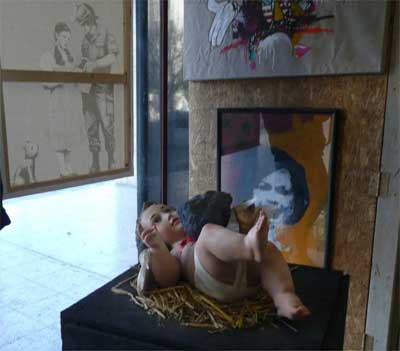
The ‘Death of Christianity’ by Banksy in Santa’s Ghetto Bethlehem
The relation between art and politics is a complex, highly problematic one, and the debate on whether there is something like ‘political art’ at all, is probably as old as the debate on how to define art. Unfortunately, much of the art displayed at Santa’s ghetto was political art in its most platitudinous and banal form. Thus, numerous works displayed political and ideologically laden symbols à la peace doves, dollar notes, national flags or colours (that is namely those of the USA, Israel and Palestine) or even worse, the faces of George Bush and Condoleezza Rice. These symbols abundant use produced the feeling that this art was not made to irritate, but to suggest. As such, it left hardly any space for humour and interpretation, but instead stated, summarized sloppily, that it is all about evil capitalism, Israel and U.S. politics. As in the works of Peter Kennard and Kat Phillips, symbols of capitalism, death and the (Israeli) military appear apparently eclectically put together in one picture, so that one only needs to put together the loose ends in order to ‘understand’: war and occupation are about making business, capitalism means death, and the US are a global superpower, which is bad. Unfortunately, such a simplified critique of global capitalism, which often has anti-Semitic undertones to it, is not restricted to Kennard and Phillips works alone. It is this point, which disturbed me the most and let me leave the gallery deeply disappointed.
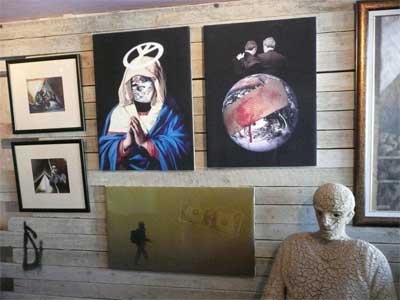
Works by Kennards and Phillips, Santa’s Ghetto Bethlehem
By now, Santa’s ghetto has moved out of Bethlehem just as the Christian pilgrims have returned home. The so-called separation barrier continues to segregate and restrict the freedom of movement in spite its new décor. Bethlehem’s taxi drivers hope for an ongoing interest in the remaining works of art by Banksy and co. in the city and offer special Banksy-tours. Interesting will be to see, what Bethlehem’s children will do with the millions of dollars they are supposed to receive...
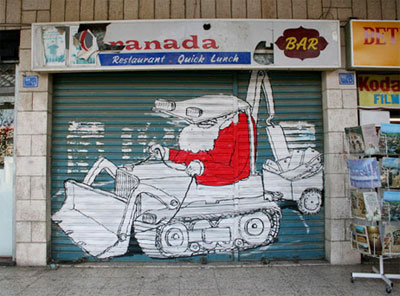
work by Blu