
/ reviews
| Yonatan Amir | 2008-09-22 13:17:18 |
on the Work of Rea Ben David
Rea Ben David. Stasis. 18.09.08-24.10.08
D&A Gallery, 57 Yhuda Halevi street , Tel Aviv
opening hours: mon- thu 11:00-19:00, fri 11:00-14:00
In aspiring to touch, unsettle, or convulse the spectator, art maintains a delicate balance between proximity and remoteness. Proximity affords viewers with the requisite measure of identification with the work, whereas remoteness inhibits the formation of a complete identification, thereby helping them reveal an unidentified and unknown aspect. Compromising one of these fundaments or the complex relations between them is liable to neutralize the potency of the creation and its wherewithal to make an impact: unbridled proximity merely duplicates the spectator’s status quo and is thus neither interesting nor moving; and a lack of affinity (or excessive distance) renders the work into something alien and detached – separate.
Relations of proximity and remoteness are latent in the essence of every work of art, and we would not have taken the trouble to even broach this topic if not for the fact that they are prominently manifest in Rea Ben David’s present exhibit.
There is something confusing about these photographs. Although they were undoubtedly taken in Israel—as evidenced by their local trappings, such as flags, signs, and license plates—they are enshrouded in a cloud of foreignness. This alien feeling is buttressed by a soft and downcast light, which is reminiscent of Europe and so different from the familiar blinding and steaming variety that informs many of the landscape photographs taken in Israel. The light in Ben David’s photos neither scorches the picture nor blackens the dark parts or whitewashes the light ones; and it refrains from beating down on the images. Instead, the light illuminates, allowing objects to be objects and colors to be colors.
The appearance of such soft light in local photographs engenders an inner paradox: the fact that the light enables the images to be ‘themselves’ (not overshadowed or blinded – not erased by the light) is what also distances them from the customary representations. Something peculiar and even disconcerting is happening here: peculiar because the familiar has never seemed so remote; and disconcerting for precisely the same reason.
During a conversation at the studio, Ben David said that he photographs while roaming about. He also admitted that on more than one occasion it seemed to him as though the situation had frozen before the picture was taken, and he merely passed by and “sampled” it. This interesting frame of reference sheds light on the apparent inherent contradiction in his work. The wanderer usually portrays the ephemeral or replaceable circumstances that were picked up on by the camera at the moment of truth, a second before the photographer continued on his way. In contrast, Ben David’s photographs appear to be still or static, as alluded to in the name of the exhibit: Stasis – a term that describes a stoppage or something that has frozen in its place. Likewise, they give the impression that had the photographer arrived on the scene a moment earlier or a moment later, this would have had no effect on the work. However, this contradiction is merely a facade, for the peripatetic element in Ben David’s work does not stem from the geographic location where the pictures were taken, but from the manner in which he chose to shoot them. His photographic meandering is technical and conscious, no less than spatial. The spatial and circumscribing aspect of his approach entails moving about the territory, while the technical-conscious part moves the area – dispatching it to another place.
According to Ben David, one of the major influences on his work is German photography from the latter half of the twentieth century. This school is identified with large series, clean and symmetrical compositions, and typological works that endeavor to locate the shared source or pattern among large groups of similar images. From among these three attributes, symmetry is the most relevant to Ben David’s work. Large series are not included in his repertoire and there is no indication of typological mapping in any of the artist’s works, while symmetry is clearly present in his photographs and constitutes a point of convergence with the above-mentioned German school. That said, it is an ironic encounter, which takes the order and neatness and stands them on their head.
In crafting symmetrical compositions informed by tidiness and minimalism, Rea Ben David is not seeking to point to a semblance of equilibrium between the various components. Instead, he avails himself of the symmetry for the purpose of highlighting the lack of order in his photographs – of highlighting the fact that many of the elements do not readily conform to the lines and forms therein. This is what happens, for example, in his photograph of the reddish-brown tennis court, which was shot at a sharp angle and configured according to the court’s outline. It is the work’s symmetrical composition and conspicuous order, of all things, that Ben David uses in order to ponder over what is unique and asymmetrical about the situation. Elements like the players’ footmarks and the rackets lying on the ground, the blurring of the lines, and the subtle fold in the middle of the net eschew a cold and typological formula and help Ben David uncover the tempestuous. By obfuscating the order, these elements bestow the photograph with life.
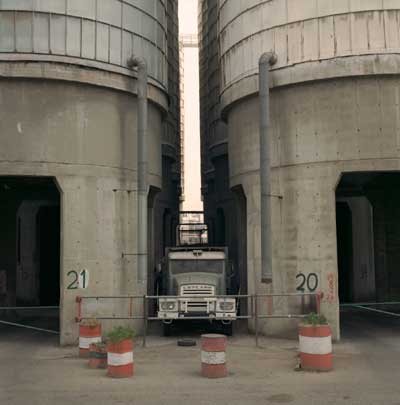
Life plays a vital role in the exhibited works. The absence of human images in most of these photographs could very well have subjugated them to the yoke of the ‘discourse of alienation and death,’ which pervades the critiques of Israeli landscape photography. In my estimation, it would be a mistake to refer to the sights in Ben David’s ‘back yards’ as further testimony to the lethal impact of urbanization, suburbanization, industrialization, and alienation processes on Israeli society and the country’s vistas. This sort of reading of the abandonment that is exposed in the photographs of the overturned mattress and the yard covered in dry leaves is liable to overlook, say, the pinkish-pale orange glimmer of the twilight hour that envelopes the mattress, which is practically radiant; the direct and mesmerizing stare of the dog that seems to revolve the rest of the picture around its face; the lyrical relationship between the concrete towers, which leave much doubt as to whether they imprison or protect, and the truck passing/hiding between those same towers; and the organic assimilation of both the shack in the field and the row of cypress tress, in another photograph.
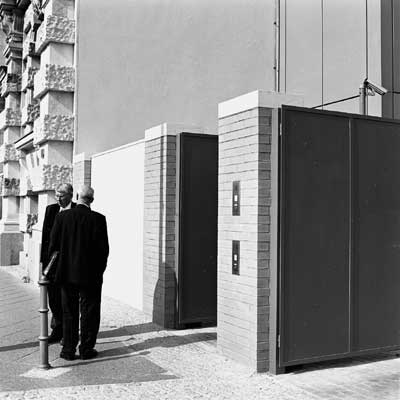
In general, Ben David’s photos do not appear to be about topical images, but relations that take form within the context of the photograph. For example, a slight fold at the bottom of a net activates the entire tennis court; a narrow space between a truck and building elicits the sense that arises from the entire photograph; in the small black-and-white photo that seals the exhibit, a security camera partakes in a game of glances that traverses a tight and calculated composition of images, buttons, and architectural elements. The relations that sprout up invite the spectator to stop and observe the photographs, which despite their clarity cannot be solved at once. From this standpoint, the name of the exhibit, Stasis, is best interpreted not as a stand-still but as a lingering.